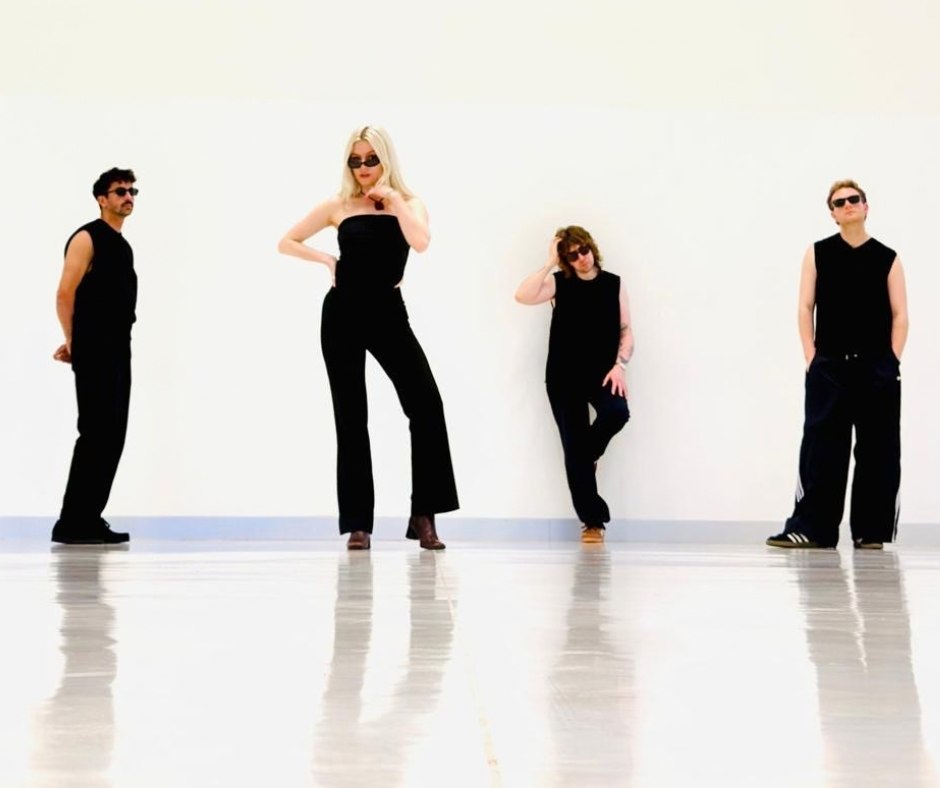
Main Stage | Fri 25 June 2027
Bio
The Sound Of A Band Kicking Down Their Own Door
Swim School sound like a band that finally kicked down their own door. Edinburgh after hours: sodium lights on wet stone, Waverley platform humming while you decide whether to go home or become someone new. They chose the latter. They discarded their safety rails – no click, no backing-track exoskeleton and have made a debut album that breathes, shoves, and occasionally stares you down.
“This album is what happens when you find the true confidence in yourself and you stop listening to everybody else.” Alice
The new skin isn’t costume, it’s an ultimatum. Think Trainspotting defiance without the tartan cosplay: proud of place, allergic to bullshit. They stayed in Edinburgh while the spreadsheets said “move to Glasgow,” and you can hear the love/hate relationship with their city hard wired into the songs – the ache for small rooms being turned into flats, the vow to be louder than the noise around them. The band’s inner cinema is colour-soaked and specific; Alice’s quick take might be the purest: “I think the this record is the colour green.” And the city map is literal: “Walking down the Mound… leaving the Old Town… towards the New Town.”
“I just couldn’t hear us playing these songs to a click” Lewis
The pivot happened mid-session. Playback rolls; Lewis turns in his chair and calls it. The room exhales. Alice follows: “We can’t actually hear any of this album being played to click or track… we can imagine it being raw.” Decision made. Remove the perfection , call the bassist, play like a band again. Lee steps in and the songs come alive. “When I got asked to be a member of the band, the answer was in seconds,” he says “because it already felt real on stage”.
“We just turned up the amps… and it was like, shit, this is really something.” Lee
You hear the shift in “Green Eyes,” which begins with Alice (yes, the singer) writing the bassline and dragging the track by the throat. Dirty low end (she was immersed in The Cure’s catalogue at that time) a possessive, spooky love lyric that would be embarrassing if it didn’t land so hard. “Just like the moon needs light to shine, need your love to come out,” she sings, laughing at herself for going “all hippy, singing about the moon and shit”. They jammed it the old way - amps up, no SPD, timing human enough to be perfectly imperfect. Across the record the ghost of the grid rattles the walls: “There’s a lot of tambourine on this record… that’s become the timekeeper,” Billy says. “You need to have your delays and reverbs back - that’s your band!” Iain Berryman (producer) Guitars tried sobriety and relapsed with purpose. Lewis stripped away their constellation of delay and reverb; the song, and Iain, pushed back. The songs snap into focus: Fender offsets → pedals → Marshall amps. The holy trinity. Sometimes the chassis purrs like classic rock (“On & On”), but the edges are new. “I’m not a drummer, I’m a musician… I play to the song.” Billy Billy drums like a grown-up. No mugging, no gymnastics. With fewer synth beds and no click, his dynamics conduct the rises and drops. Space becomes weight; choruses feel like decisions, not automation. “We did the first version I loved… the second the boys loved… the third was a Frankenstein and now I love it.” Alice, on “Say It All” They fight for songs, not egos. “Say It All” nearly died twice before returning as a stitched-together winner: first-pass drums, second-session guitars, first-session bass. If it serves the track, it stays; if it flatters you and kills momentum, it dies. Theme-wise, they don’t dodge it. “Good Enough Now” is the pressure gauge: plain language for a complicated trade. “How much more until it gives / when I’ve left my life behind for this,” Alice sings, capturing the cost of betting on the thing you love while the algorithm asks for another blood sample. The album shuts the door with defiance, not a whimper: “Am I good enough now?” After 35 minutes of proof, the question hangs like breath in winter, and the answer is “Yes, Alice…you are”. Live, the first 90 seconds are a declaration: feedback, bass growl, guitars at the edge of control, then a snap to clarity that says they built this to move without training wheels. No barrier in the mind or the venues, just bodies, air pressure, and the sensation that a chorus can rearrange furniture. File under: precision-dark guitar music; Edinburgh at midnight; confidence under duress; ringing ears on the walk back up the Mound, grinning anyway.Read more…Read more…